
For Mission-Driven Leaders
The Inner Work of Outer Change
5000+
Leaders served
Grounded Idealist helps mission-driven leaders and organizations develop the inner capacities to lead through complexity, confront our most pressing global challenges, and channel these capacities into lives of purpose and service.
We do this by helping individuals deepen awareness and vision, shift their mindset and relationship to life’s challenges, clarify their areas of growth, and develop a systems- and futures-informed perspective to align their growth and development with what the world needs. We offer a series of customized courses and programs to support you, whether you’re early in your career, in a new role, navigating an unexpected transition, or hitting refresh on your dreams entirely.
In life, what we water grows. For big dreams to take root, they need healthy inner and social soil. That’s where our work begins.
Coaching Collaborative
During moments of uncertainty and deep transition, coaching can help you process, learn, and grow into whatever comes. Your coach will support you in aligning behaviors and mindsets, building resilience, and deepening self-awareness, allowing you to turn layoffs into launchpads, and transitions into transformation.
Are you a Worker in Transition?
Sign up to receive:
3 pro bono coaching sessions
Our monthly newsletter containing valuable resources and offerings.
Live resourcing and skill-development workshops designed to support you on your journey toward your next career chapter.
$50 administrative fee required upon sign-up.
*Note: pro bono coaching is currently available for workers in transition. Others can email us to explore affordable coaching options. Scholarships available for displaced workers unable to pay (message “info@groundedidealist.co” for more information)
Root to Rise Career Navigator Program
Root to Rise is a 3-month career navigator and personal development program designed for mission-driven professionals navigating uncertainty, sector shifts, and career change. Whether you’re recovering from job loss, exploring new sectors, or reimagining your career, you don’t have to do it alone.

Note: our next cohort is planned for fall 2026. Click the link below to learn more. Reach out to us at info@groundedidealist.co if you’d like to explore customizing this program for your team.
How Change Happens
We are all increasingly aware of the real catastrophic risks to humanity and our planet. Our technological creativity and power are outpacing our developmental capacity to wield them. And this is happening just as many of the people most capable of addressing our biggest challenges struggle to find ways to contribute meaningfully.
Changemakers need new resources for working with the complexity and disruption beneath our current systems.
Our standard approach to creating change hasn't worked
If we look honestly at the past hundred years of innovation and problem-solving, the pattern is hard to miss. As a recent report from the Civilization Research Institute put it:
"The standard approaches that humanity uses to solve problems tend to create worse problems as a result of their implementation. The projects aimed at world betterment that do 'succeed' (according to their own narrow metrics) tend to do so while also generating significant externalized harm."
Countless “innovations” that were celebrated as positive breakthroughs advancing modernity, globalization, and economic growth - things like pesticides, plastics, fossil fuels, and social media - all have tremendous downsides. In the short term, they may have delivered productivity, efficiency, growth, and progress. Over time, the costs were pushed onto others and even our attempts to respond have, at times, contributed:
Chemicals. Decades of environmental activism, regulation, and new institutions have not reversed the trend: global pesticide use has roughly doubled since 1990. Now "forever chemicals" (PFAS) and microplastics are found in nearly every drop of rainwater around the world and even in the blood of newborns.
Energy. More than a trillion dollars a year goes to climate efforts, yet global fossil fuel use has barely slowed. Efficiency gains often increase total consumption, because cheaper energy opens new uses for it (the Jevons paradox).
Fixes that become new problems. When the chemicals that damage the ozone layer were banned, the replacements still harmed the climate. Ocean "dead zones" went from about 10 in 1960 to over 500 today, in part because of the runoff from fertilizers that boosted crop yields.
Social media. Platforms built to connect us have been optimized to hold our attention. The result: misinformation amplified, privacy eroded, polarization fueled, and spikes in anxiety and depression among users.
None of this is mainly a story about bad intentions. Most of these efforts were led by capable, well-meaning people responding to real needs. The failure is one of scope, time horizon, and our illusion of separateness. When we draw the boundary of analysis too tightly, we optimize for what's inside it and miss what's outside. The harm doesn't disappear. It shows up elsewhere, often later and often larger, and it sets up the next round of problems.
The skills that make someone successful in conventional systems, such as focusing on narrow goals, measuring what's easy to measure, and scaling fast, are the same ones that can unknowingly reproduce the problem. The more successful we are by the usual measures, the more important it is to ask what we're not seeing.
What changemakers need now
If the standard playbook creates new crises, then working harder inside it won't be enough. Mission-driven leaders need a different foundation:
Systems thinking to see feedback loops, unintended consequences, and root causes, rather than treating symptoms one issue at a time.
Wide boundary analysis to ask, before we act, who and what is affected across the whole system and over time. This also means asking who benefits from the problem staying unsolved.
Cognitive complexity and inner development to hold uncertainty without rushing to a fix, weigh competing values, understand the power of our nervous system and presence to transmit coherence or dysregulation, and notice our own blind spots and motivated reasoning.
No method works better than the person using it, so these capacities have to grow together.
One thing is clear: “The success of an intervention depends on the inner condition of the intervener.” - Bill O'Brien
We cannot build healing and flourishing systems with dysregulated bodies.
That is the work we're here to support: helping changemakers build the scope, wisdom, self-awareness, and flourishing ecosystems to match the complexity of the world they're trying to heal.
From Source to Service™
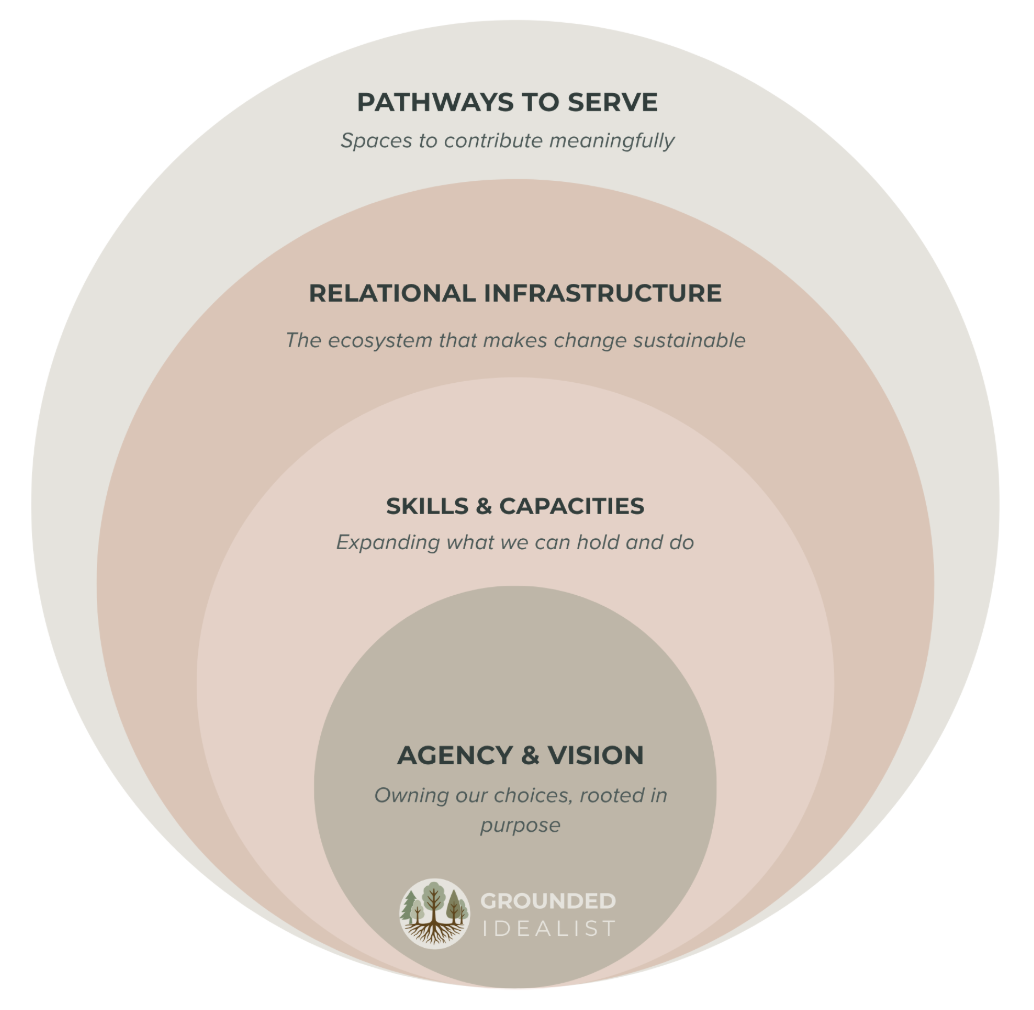
Grounded Idealist has developed and tested a number of powerful tools and approaches to creating lasting systems and social change. One tool, “From Source to Service,” is a guided process that moves us from the source of our purpose to the empowered pathways that activate us. We believe these 4 elements are critical:
Agency & Vision
Skills & Capabilities
Relational Infrastructure
Pathways to Serve
Complete this sentence: If we do ____, the world gets better because ____. What would you say?
This is your draft Theory of Change. Let it guide you. This brings you closer to your formula for creating change.
What pathways exist for me to serve?
-
HiringCoach.AI is an AI job search platform specifically designed for mission-driven job seekers. It tailors your resume and cover letter to a specific role, checks your fit before you apply, prepares you for the interview, and more!
Check out Mission Control!
-
Civic Match is a nonpartisan program connecting mission-driven professionals with meaningful roles in state and local governments across the country.
Check out their Talent Accelerator!
-
Through nonpartisan programming, training, and mentorship, New Politics Academy helps leaders prepare to serve their communities and country again - this time through politics.
Check out their Foundations & Answering the Call programs!